 |
Ships from and sold by Amazon.com 19 new or used available from $15.37 Average customer review: |
Product Description
“Fascists,” “Brownshirts,” “jackbooted stormtroopers”—such are the insults typically hurled at conservatives by their liberal opponents. Calling someone a fascist is the fastest way to shut them up, defining their views as beyond the political pale. But who are the real fascists in our midst?
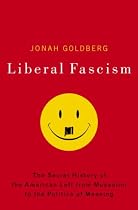
Liberal Fascism offers a startling new perspective on the theories and practices that define fascist politics. Replacing conveniently manufactured myths with surprising and enlightening research, Jonah Goldberg reminds us that the original fascists were really on the left, and that liberals from Woodrow Wilson to FDR to Hillary Clinton have advocated policies and principles remarkably similar to those of Hitler's National Socialism and Mussolini's Fascism.
Contrary to what most people think, the Nazis were ardent socialists (hence the term “National socialism”). They believed in free health care and guaranteed jobs. They confiscated inherited wealth and spent vast sums on public education. They purged the church from public policy, promoted a new form of pagan spirituality, and inserted the authority of the state into every nook and cranny of daily life. The Nazis declared war on smoking, supported abortion, euthanasia, and gun control. They loathed the free market, provided generous pensions for the elderly, and maintained a strict racial quota system in their universities—where campus speech codes were all the rage. The Nazis led the world in organic farming and alternative medicine. Hitler was a strict vegetarian, and Himmler was an animal rights activist.
Do these striking parallels mean that today’s liberals are genocidal maniacs, intent on conquering the world and imposing a new racial order? Not at all. Yet it is hard to deny that modern progressivism and classical fascism shared the same intellectual roots. We often forget, for example, that Mussolini and Hitler had many admirers in the United States. W.E.B. Du Bois was inspired by Hitler's Germany, and Irving Berlin praised Mussolini in song. Many fascist tenets were espoused by American progressives like John Dewey and Woodrow Wilson, and FDR incorporated fascist policies in the New Deal.
Fascism was an international movement that appeared in different forms in different countries, depending on the vagaries of national culture and temperament. In Germany, fascism appeared as genocidal racist nationalism. In America, it took a “friendlier,” more liberal form. The modern heirs of this “friendly fascist” tradition include the New York Times, the Democratic Party, the Ivy League professoriate, and the liberals of Hollywood. The quintessential Liberal Fascist isn't an SS storm trooper; it is a female grade school teacher with an education degree from Brown or Swarthmore.
These assertions may sound strange to modern ears, but that is because we have forgotten what fascism is. In this angry, funny, smart, contentious book, Jonah Goldberg turns our preconceptions inside out and shows us the true meaning of Liberal Fascism.
Product Details
- Amazon Sales Rank: #8 in Books
- Published on: 2008-01-08
- Released on: 2008-01-08
- Number of items: 1
- Binding: Hardcover
- 496 pages
Editorial Reviews
About the Author
JONAH GOLDBERG is a columnist for the Los Angeles Times and contributing editor to National Review. A USA Today contributor and former columnist for the Times of London, he has also written for The New Yorker, Commentary, the Wall Street Journal, and many other publications. He lives in Washington, D.C.
Excerpt. © Reprinted by permission. All rights reserved.
* 1 *
Mussolini:
The Father of Fascism
You’re the top!
You’re the Great Houdini!
You’re the top!
You are Mussolini!
—An early version of the Cole Porter song “You’re the Top” (1)
IF YOU WENT solely by what you read in the New York Times or the New York Review of Books, or what you learned from Hollywood, you could be forgiven for thinking that Benito Mussolini came to power around the same time as Adolf Hitler—or even a little bit later—and that Italian Fascism was merely a tardy, watered–down version of Nazism. Germany passed its hateful race policies—the Nuremberg Laws—in 1935, and Mussolini’s Italy followed suit in 1938. German Jews were rounded up in 1942, and Jews in Italy were rounded up in 1943. A few writers will casually mention, in parenthetical asides, that until Italy passed its race laws there were actually Jews serving in the Italian government and the Fascist Party. And on occasion you’ll notice a nod to historical accuracy indicating that the Jews were rounded up only after the Nazis had invaded northern Italy and created a puppet government in Salo. But such inconvenient facts are usually skipped over as quickly as possible. More likely, your understanding of these issues comes from such sources as the Oscar–winning film Life Is Beautiful, (2) which can be summarized as follows: Fascism arrived in Italy and, a few months later, so did the Nazis, who carted off the Jews. As for Mussolini, he was a bombastic, goofy–looking, but highly effective dictator who made the trains run on time.
All of this amounts to playing the movie backward. By the time Italy reluctantly passed its shameful race laws—which it never enforced with even a fraction of the barbarity shown by the Nazis—over 75 percent of Italian Fascism’s reign had already transpired. A full sixteen years elapsed between the March on Rome and the passage of Italy's race laws. To start with the Jews when talking about Mussolini is like starting with FDR’s internment of the Japanese: it leaves a lot of the story on the cutting room floor. Throughout the 1920s and well into the 1930s, fascism meant something very different from Auschwitz and Nuremberg. Before Hitler, in fact, it never occurred to anyone that fascism had anything to do with anti–Semitism. Indeed, Mussolini was supported not only by the chief rabbi of Rome but by a substantial portion of the Italian Jewish community (and the world Jewish community). Moreover, Jews were overrepresented in the Italian Fascist movement from its founding in 1919 until they were kicked out in 1938.
Race did help turn the tables of American public opinion on Fascism. But it had nothing to do with the Jews. When Mussolini invaded Ethiopia, Americans finally started to turn on him. In 1934 the hit Cole Porter song “You’re the Top” engendered nary a word of controversy over the line “You are Mussolini!” When Mussolini invaded that poor but noble African kingdom the following year, it irrevocably marred his image, and Americans decided they had had enough of his act. It was the first war of conquest by a Western European nation in over a decade, and Americans were distinctly unamused, particularly liberals and blacks. Still, it was a slow process. The Chicago Tribune initially supported the invasion, as did reporters like Herbert Matthews. Others claimed it would be hypocritical to condemn it. The New Republic—then in the thick of its pro–Soviet phase—believed it would be “naive” to blame Mussolini when the real culprit was international capitalism. And more than a few prominent Americans continued to support him, although quietly. The poet Wallace Stevens, for example, stayed pro–Fascist. “I am pro–Mussolini, personally,” he wrote to a friend. “The Italians,” he explained, “have as much right to take Ethiopia from the coons as the coons had to take it from the boa–constrictors.” (3) But over time, largely due to his subsequent alliance with Hitler, Mussolini’s image never recovered.
That's not to say he didn't have a good ride.
In 1923 the journalist Isaac F. Marcosson wrote admiringly in the New York Times that “Mussolini is a Latin [Teddy] Roosevelt who first acts and then inquires if it is legal. He has been of great service to Italy at home.” (4) The American Legion, which has been for nearly its entire history a great and generous American institution, was founded the same year as Mussolini’s takeover and, in its early years, drew inspiration from the Italian Fascist movement. “Do not forget,” the legion’s national commander declared that same year, “that the Fascisti are to Italy what the American Legion is to the United States.” (5)
In 1926 the American humorist Will Rogers visited Italy and interviewed Mussolini. He told the New York Times that Mussolini was “some Wop.” “I’m pretty high on that bird.” Rogers, whom the National Press Club had informally dubbed “Ambassador–at–Large of the United States,” wrote up the interview for the Saturday Evening Post. He concluded, “Dictator form of government is the greatest form of government: that is if you have the right Dictator.” (6) In 1927 the Literary Digest conducted an editorial survey asking the question: “Is there a dearth of great men?” The person named most often to refute the charge was Benito Mussolini—followed by Lenin, Edison, Marconi, and Orville Wright, with Henry Ford and George Bernard Shaw tying for sixth place. In 1928 the Saturday Evening Post glorified Mussolini even further, running an eight–part autobiography written by Il Duce himself. The series was gussied up into a book that gained one of the biggest advances ever given by an American publisher.
And why shouldn’t the average American think Mussolini was anything but a great man? Winston Churchill had dubbed him the world’s greatest living lawgiver. Sigmund Freud sent Mussolini a copy of a book he co–wrote with Albert Einstein, inscribed, “To Benito Mussolini, from an old man who greets in the Ruler, the Hero of Culture.” The opera titans Giacomo Puccini and Arturo Toscanini were both pioneering Fascist acolytes of Mussolini. Toscanini was an early member of the Milan circle of Fascists, which conferred an aura of seniority not unlike being a member of the Nazi Party in the days of the Beer Hall Putsch. Toscanini ran for the Italian parliament on a Fascist ticket in 1919 and didn’t repudiate Fascism until twelve years later. (7)
Mussolini was a particular hero to the muckrakers—those progressive liberal journalists who famously looked out for the little guy. When Ida Tarbell, the famed reporter whose work helped break up Standard Oil, was sent to Italy in 1926 by McCall’s to write a series on the Fascist nation, the U.S. State Department feared that this “pretty red radical” would write nothing but “violent anti–Mussolini articles.” Their fears were misplaced. Tarbell was wooed by the man she called “a despot with a dimple,” praising his progressive attitude toward labor. Similarly smitten was Lincoln Steffens, another famous muckraker, who is today perhaps dimly remembered for being the man who returned from the Soviet Union declaring, “I have been over into the future, and it works.” Shortly after that declaration, he made another about Mussolini: God had “formed Mussolini out of the rib of Italy.” As we’ll see, Steffens saw no contradiction between his fondness for Fascism and his admiration of the Soviet Union. Even Samuel McClure, the founder of McClure’s Magazine, the home of so much famous muckraking, championed Fascism after visiting Italy. He hailed it as “a great step forward and the first new ideal in government since the founding of the American Republic.” (8)
Meanwhile, almost all of Italy’s most famous and admired young intellectuals and artists were Fascists or Fascist sympathizers (the most notable exception was the literary critic Benedetto Croce). Giovanni Papini, the “magical pragmatist” so admired by William James, was deeply involved in the various intellectual movements that created Fascism. Papini’s Life of Christ—a turbulent, almost hysterical tour de force chronicling his acceptance of Christianity—caused a sensation in the United States in the early 1920s. Giuseppe Prezzolini, a frequent contributor to the New Republic who would one day become a respected professor at Columbia University, was one of Fascism’s earliest literary and ideological architects. F. T. Marinetti, the founder of the Futurist movement—which in America was seen as an artistic companion to Cubism and Expressionism—was instrumental in making Italian Fascism the world's first successful “youth movement.” America's education establishment was keenly interested in Italy’s “breakthroughs” under the famed “schoolmaster” Benito Mussolini, who, after all, had once been a teacher.
Perhaps no elite institution in America was more accommodating to Fascism than Columbia University. In 1926 it established Casa Italiana, a center for the study of Italian culture and a lecture venue for prominent Italian scholars. It was Fascism’s “veritable home in America” and a “schoolhouse for budding Fascist ideologues,” according to John Patrick Diggins. Mussolini himself had contributed some ornate Baroque furniture to Casa Italiana and had sent Columbia’s president, Nicholas Murray Butler, a signed photo thanking him for his “most valuable contribution” to the pro...
Customer Reviews
A fascinating book
A very interesting book on the intellectural roots of modern liberalism. The author must have really struck a nerve given the vitriolic, over-the-top responses of some of the critics on this site. If the book wasn't as well put together and interesting as this one indeed is, then then these knee-jerk critics would not feel threatened enough to bother with their howling. Read it for yourself and you decide.
Clever Polemic; Useless History
Fascism was a specific political movement with very particular characteristics. The word "fascist" is and has been ignorantly thrown around a lot, especially by overheated leftist college students, but that's no reason to twist its meaning even further. Just because it's comforting for some segments of the conservative electorate to believe that modern American liberals are the heirs of Adolf Hitler doesn't make it correct.
The biggest problem with the book is that Goldberg's definition of fascism is so broad to make it virtually useless. In his view, any kind of collective or government action is "fascist". He concentrates on Woodrow Wilson's activities during WW1 as an example, and brings FDR into the fascist fold, but based on the fuzzy set of criteria that Goldberg sets forth not only is Wilson and FDR "fascist", but Abraham Lincoln, Ronald Reagan and Teddy Roosevelt could be also. In Mr. Goldberg's world, World War 2 was fought entirely by Fascists, Fascist Germans, Italians and Japanese, vs. Fascist Soviets allied with Fascist Americans. In short, it's premise is sloppy. Mr. Goldberg refuses compensate for historical context. Comparing 1930s political economy to that of today's is something that should be done very carefully. Capitalism was widely regarded as a failure in the 1930s, and virtually all industrial countries tinkered with it, including American conservatives (think Smoot-Hawley).
And that is the biggest blind alley in this work. By concentrating on political economy Goldberg ignores the more important markers of Fascism. Fascists were notoriously uninterested in economics, and Fascist political economy, such as it was, was a pastiche of free market capitalism, corporatism and socialism, and in most countries where it was ascendant it lazily morphed into support for the status quo, i.e. protecting wealthy landowners and business owners. What made Fascism a distinctive political movement was not a centrally planned economy but militarism, racial chauvinism, and a sort of false, golden age, nostalgia for monarchism, Fascism's closest relative, which is why fascist movements, especially in southern Europe attracted monarchists into their ranks.
Mr. Goldberg doesn't address these more cogent descriptors of fascism because it would contradict his thesis. Since most American liberals are less militaristic then his own conservative base, to highlight Fascism's militarism would destroy his argument. And by neglecting Fascism's kitcsh-laden obsession with the nuclear family, he avoids uncomfortable comparison's with American social conservatism. And by dismissing Fascism's anti-communism as mere factional competition, he ignores Fascism's most important base--lower middle class shop owners and artisans, terrified of losing their property in a Marxist revolution. Hitler did admire Stalin's totalitarianism, but he hated Marxism, which if Mr. Goldberg cracked open Mein Kampf, he would know.
But I suspect Mr. Goldberg does know, which is why in the end his book is so dishonest. It is not an inquiry of history or politics, it's a partisan polemic, which is fine, but buyers should know that when they buy it.
A good free read
I read this book over a couple of visits to a nationally-known book seller. I won't name the seller but it's the one with comfy chairs strewn around the floor.
I certainly wouldn't spend much money on this thing. (I see that Amazon has already deeply reduced its price, from $27.95, marked down to $15.37.)
I'm rating it one star because that's the smallest rating available.
I eagerly await its place on the Conservative Book Club's $1.00 list.
At $1.00 it makes a good door stop.
I am looking forward to the sequel to this book, because I have a pair of French doors in my house.


No comments:
Post a Comment